Your returned check demand letter, ready in minutes
For landlords, small businesses, and service providers whose customer’s check bounced. Fill out the form, watch a live preview, and download your document as a print-ready PDF. Send it certified mail as the first step before small claims court.
| Check Number | # |
| Check Date | |
| Original Amount | $0.00 |
| Return Reason | |
| Total Amount Due | $0.00 |
Preview locked
Complete payment to download
What to expect
While on the form
- What you fill here ends up on your document, no extra data requested
- Live preview updates as you go, inline hints flag accidental mistakes
- Chatbot responses on this page, typically within 24 business hours
At checkout
- A flat $9 transaction. No extra fees, no surprise charges
- Stripe handles your payment data, we never see it
- Processing fees come out of our end, not added to your total
After payment
- Print-ready PDF and JPG, emailed and downloadable instantly
- Your inputs are wiped after delivery, only your email and order details kept for billing
- Hassle-free refund policy (see below)
See a sample
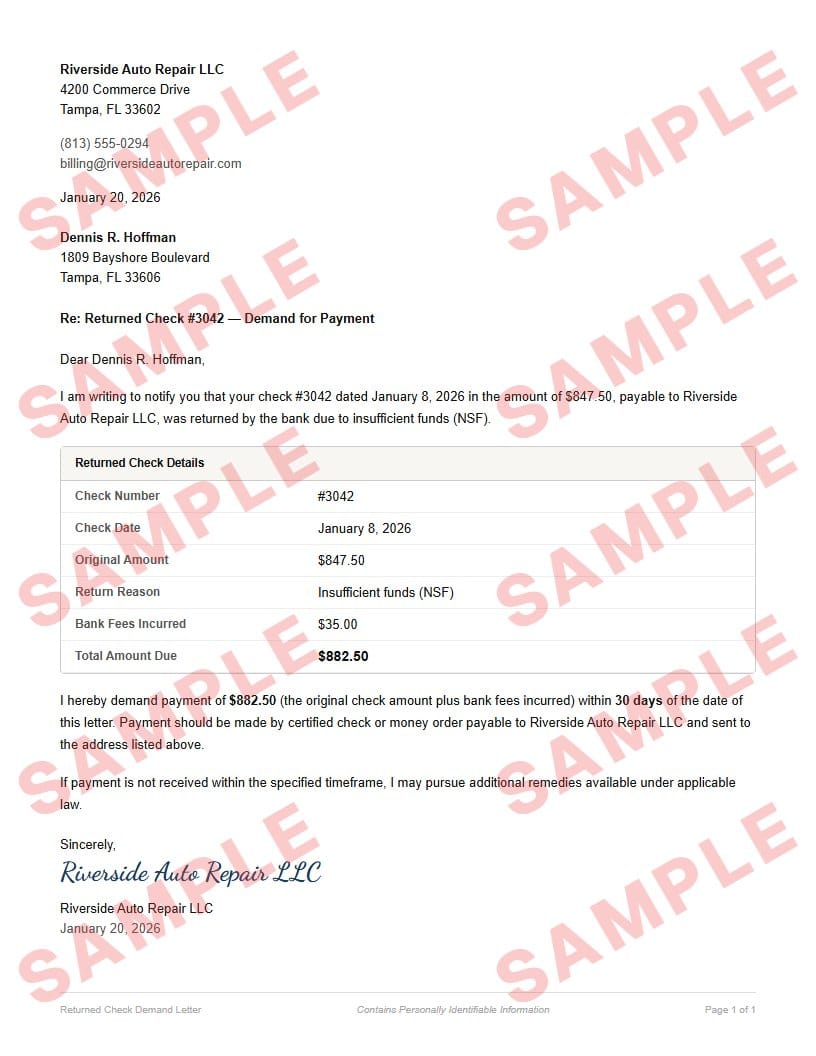
Everything you see here — the formatting, the text, the layout — is exactly what your final document will look like. Only the inputted fields will be replaced with your details.
You can download a sample JPG to keep; the download is intentionally watermarked and slightly pixelated, but both your final PDF and JPG will be crisp and clean.
Refund policy
You’re covered if your delivered document doesn’t match the watermarked sample’s layout or formatting. Email [email protected] with the document attached, and we’ll get back within 2 business days with either a refund or an updated document — whichever you prefer.
We don’t typically cover typos or input mistakes — unless you catch us in a good mood.
What is a returned check demand letter?
A returned check demand letter is a formal notice sent to someone whose check was returned by the bank for insufficient funds (NSF), a closed account, or another reason. The letter demands payment of the original check amount plus any fees incurred, and establishes a deadline for payment before further action is taken.
Sending a written demand letter is typically the first step before pursuing legal remedies for a bounced check. It creates a documented record of the demand, gives the check writer a reasonable opportunity to make good on the payment, and demonstrates that you attempted to resolve the matter before escalating to small claims court or involving law enforcement.
Some organizations also request a voided check alongside this document. Generate a voided check →
Want the background first? Learn more about credit & disputes →
Step-by-step guide: How to demand payment on a bounced check →
Loved by our customers
Over 1.2 million documents generated for more than 8,000 happy customers
Tenant Paid Within a Week
My tenant’s rent check bounced and they weren’t responding to texts. Sent this demand letter certified mail and had a cashier’s check in hand six days later. The formal letter got their attention.
Frank M.
Recovered the Full Amount
A client’s check for landscaping work came back NSF. I sent the demand letter requesting the original amount plus my bank’s $30 return fee. They paid everything within the deadline. No court needed.
Lisa H.
Professional First Step
Before going to small claims court, my attorney suggested sending a formal demand letter first. This form was exactly what we needed — professional, documented, and it resolved the issue without litigation.
Howard T.
Frequently asked questions
What are the common mistakes to avoid when filling out this form?▼
- Not including the bank’s return fee in the demandYour bank likely charged you a returned check fee. Most states allow you to recover this fee from the check writer. Include it in your demand amount along with the original check amount.
- Setting an unreasonable deadlineGive the check writer 15–30 days to respond. Too short (less than 10 days) may seem unreasonable in court. Too long lets the matter drag without resolution.
- Not sending by certified mailIf you end up in small claims court, you need proof the check writer received your demand. Certified mail with return receipt provides that proof. Regular mail does not.
- Skipping the demand letter and going straight to courtMost small claims courts and prosecutors expect you to attempt resolution first. A demand letter shows good faith and is often required before filing a claim or pressing charges.
What should I do when a check bounces?▼
First, contact your bank to confirm the return reason. Then send a formal demand letter to the check writer requesting payment of the original amount plus any bank fees you incurred. Give them a reasonable deadline (typically 15–30 days). If they don’t pay, you may pursue the matter in small claims court.
Can I charge fees for a returned check?▼
Most states allow you to recover bank fees you incurred due to the bounced check. Some states also allow additional statutory damages. The demand letter should include the original check amount plus any fees your bank charged you. Check your state’s specific laws for allowable recovery amounts.
How long should I give the check writer to pay?▼
A reasonable timeframe is typically 15 to 30 days from the date of the letter. This gives the person enough time to receive the letter and arrange payment, while not allowing the matter to drag on indefinitely.
Should I send the demand letter by certified mail?▼
Yes. Sending via certified mail with return receipt creates proof that the check writer received your demand. This documentation is important if you later need to pursue the matter in court.
What if the check writer doesn’t respond to my demand letter?▼
If the check writer fails to pay within the deadline, you may file a claim in small claims court, report the matter to your local district attorney, or consult an attorney about your options. The demand letter serves as evidence that you gave them an opportunity to pay before taking further action.
Is writing a bad check a crime?▼
In most states, knowingly writing a check on an account with insufficient funds is a criminal offense. However, most prosecutors require evidence that the check writer was notified and given an opportunity to make good on the payment before pursuing criminal charges. The demand letter serves this purpose.
Key terms
- NSF (Non-Sufficient Funds)
- A bank return reason meaning the check writer’s account did not have enough money to cover the check amount when it was presented for payment.
- Demand letter
- A formal written notice demanding payment of a specific amount by a specific deadline. Often a prerequisite before pursuing legal action.
- Returned check fee
- A fee charged by your bank when a deposited check is returned unpaid. Typically $10–$35, and usually recoverable from the check writer.
- Small claims court
- A local court that handles disputes involving relatively small dollar amounts (limits vary by state, usually $5,000–$10,000). The typical next step if a demand letter goes unanswered.
- Certified mail
- A USPS service that provides proof of mailing and delivery. Return receipt adds a signed confirmation — essential evidence if the matter goes to court.
Google Policies
My Check Pros is a document generation tool and is not affiliated with, endorsed by, or in any way officially connected with any financial institutions mentioned. Read our disclaimer.
My Check Pros is owned and operated by Miruvor, an independent studio based in Washington, D.C., focused on researching and building in the payments, fintech and agentic AI space.