Your bank details sharing letter, ready in minutes
For anyone who needs to share bank account details with a third party for incoming payments or transfers. Fill out the form, watch the live preview, and download a print-ready PDF letter containing your routing number, account number, and SWIFT code.
| Account Holder Name | |
| Address |
| Financial Institution | |
| Account Type | Checking |
| Routing / ABA Number | |
| Account Number |
Preview locked
Complete payment to download
What to expect
While on the form
- What you fill here ends up on your document, no extra data requested
- Live preview updates as you go, inline hints flag accidental mistakes
- Chatbot responses on this page, typically within 24 business hours
At checkout
- A flat $9 transaction. No extra fees, no surprise charges
- Stripe handles your payment data, we never see it
- Processing fees come out of our end, not added to your total
After payment
- Print-ready PDF and JPG, emailed and downloadable instantly
- Your inputs are wiped after delivery, only your email and order details kept for billing
- Hassle-free refund policy (see below)
See a sample
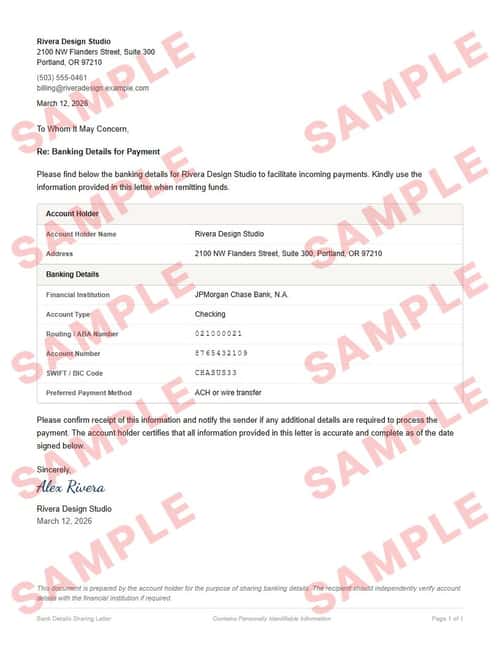
Everything you see here — the formatting, the text, the layout — is exactly what your final document will look like. Only the inputted fields will be replaced with your details.
You can download a sample JPG to keep; the download is intentionally watermarked and slightly pixelated, but both your final PDF and JPG will be crisp and clean.
Refund policy
You’re covered if your delivered document doesn’t match the watermarked sample’s layout or formatting. Email [email protected] with the document attached, and we’ll get back within 2 business days with either a refund or an updated document — whichever you prefer.
We don’t typically cover typos or input mistakes — unless you catch us in a good mood.
What is a bank details sharing letter?
A bank details sharing letter is a formal document that provides your banking information — routing number, account number, account type, and optionally a SWIFT/BIC code — to a third party so they can send you money. Whether you’re receiving payment from a client, setting up a vendor relationship, or providing details for a wire transfer, a written letter is more secure and reliable than sending account numbers over email or text.
The letter confirms the account holder’s identity, specifies the financial institution, and presents the banking details in a structured format that the recipient can hand to their own bank or accounting department. It also creates a paper trail showing exactly what information was shared and when.
Some organizations also request a voided check alongside this document. Generate a voided check →
Want the background first? Learn more about banking & bank accounts →
Step-by-step guide: How to safely share your bank details →
Loved by our customers
Over 1.2 million documents generated for more than 8,000 happy customers
Client Paid Me the Same Day
Had a new client who needed my banking details for a wire transfer. Instead of going back and forth over email with sensitive numbers, I filled this out and sent the PDF. Clean, professional, and the payment landed same day.
Carlos M.
Exactly What My Accountant Asked For
My accountant needed banking details on letterhead for a vendor setup. This gave me a formatted document in under five minutes. No fussing with Word templates or worrying about missing a field.
Natasha R.
Safer Than a Screenshot
I used to text a photo of my check to share bank details. This is way better — it looks professional, includes only what the recipient needs, and I have a record of exactly what I shared.
James W.
Frequently asked questions
What are the common mistakes to avoid when filling out this form?▼
- Sending bank details over unencrypted emailPlain email is not secure. If you must email your letter, send it as a password-protected PDF and share the password through a different channel (text, phone call). Better yet, deliver the letter in person or by certified mail.
- Confusing routing number with account numberYour routing number (9 digits) identifies your bank. Your account number (4–17 digits) identifies your specific account. On a check, the routing number is on the bottom left and the account number is next to it. Double-check both before sharing.
- Using the wrong routing number for wire transfersMany banks have different routing numbers for ACH transfers and wire transfers. If the sender is wiring funds, confirm with your bank which routing number to use — the one on your checks may be ACH-only.
- Forgetting to specify the account typeThe sender’s bank or payroll system usually requires the account type (checking, savings, or money market) to process the transfer. Omitting it can delay the payment or cause it to be returned.
What information does a bank details sharing letter include?▼
The letter includes your name, address, financial institution, routing number, account number, account type, and optionally a SWIFT/BIC code for international transfers. You can also specify your preferred payment method (ACH, wire, or check).
Is it safe to share my bank details in a letter?▼
A formal letter is safer than sending account numbers in a plain email or text message. The letter is a structured document you control — you decide who receives it and how it’s delivered. For maximum security, deliver it in person, by certified mail, or as a password-protected PDF.
Do I need a SWIFT code?▼
Only if the sender is transferring funds internationally. Domestic ACH and wire transfers within the United States use your routing number and account number. If you’re not sure whether the sender needs a SWIFT code, ask them — or leave it off and add it later if requested.
Can I use this letter for direct deposit?▼
This letter shares your bank details with a third party for incoming payments. If your employer specifically requires a direct deposit authorization form, use our dedicated direct deposit authorization product instead — it includes the employer-specific authorization language that payroll departments expect.
What is the difference between ACH and wire transfer?▼
ACH (Automated Clearing House) transfers are batch-processed, typically free or low-cost, and settle in 1–3 business days. Wire transfers are processed individually, arrive same-day or next-day, but carry fees (usually $15–$30 domestic, $30–$50 international). Both use your routing and account number.
Can a business use this letter?▼
Yes. The letter works for individuals and businesses alike. If you’re sharing details for a business account, enter the business name in the full name field. The letter format is the same regardless of whether the account holder is a person or a company.
Key terms
- Routing number
- A 9-digit code that identifies your bank or credit union within the U.S. banking system. Also called an ABA routing transit number. Every bank branch has one, and it’s printed on the bottom-left of your checks.
- Account number
- A unique number assigned to your bank account, typically 4 to 17 digits. Combined with the routing number, it tells the sender’s bank exactly where to deposit funds.
- SWIFT/BIC code
- An 8- or 11-character international bank identifier used for cross-border wire transfers. U.S. domestic transfers (ACH) do not require a SWIFT code — it’s only needed when funds originate from or pass through a foreign bank.
- ACH (Automated Clearing House)
- The U.S. electronic payment network that processes direct deposits, bill payments, and bank-to-bank transfers. ACH transactions are batch-processed and typically settle in 1–3 business days.
- Wire transfer
- A same-day or next-day electronic funds transfer processed individually through the Federal Reserve (Fedwire) or SWIFT network. Faster than ACH but carries per-transaction fees, typically $15–$50 depending on whether it’s domestic or international.
Google Policies
My Check Pros is a document generation tool and is not affiliated with, endorsed by, or in any way officially connected with any financial institutions mentioned. Read our disclaimer.
My Check Pros is owned and operated by Miruvor, an independent studio based in Washington, D.C., focused on researching and building in the payments, fintech and agentic AI space.